|
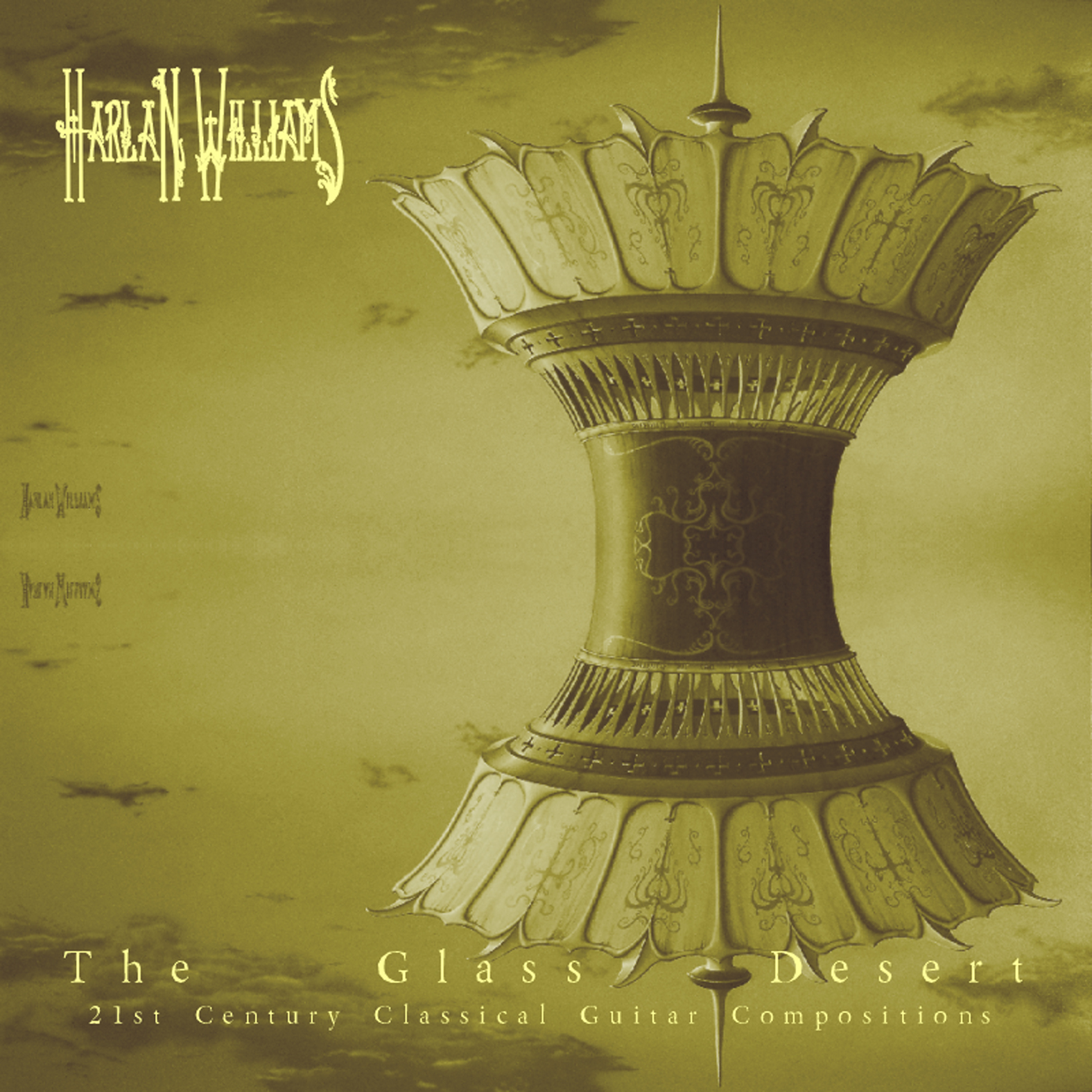
 Harlan Williams : The Glass Desert.
Beautiful dark and airy guitar compositions.
The compositions on The Glass Desert are instrumental and range in moods from
ambient and celestial to darkened and tragic, always with a layering of
harmonies and an intricate structure. The writings are usually in minor key and
can sometimes end up gothic sounding. The style is very unlike traditional
classical guitar music, using multiple instrument parts, elaborate arrangements,
and unusual timings.
The front cover artwork is one of Harlan's original paintings. These detailed
works have been on display in galleries in North Carolina and Louisiana. The
subjects are all structural or things that don't actually exist, sometimes
taking as long as an entire year to finish.
All of the song titles on this recording are found somewhere in the scope of
Christian history or directly in the Bible itself. For example, "In Nomine
Domini" is Latin for "In the Name of the Lord", "Gregory IX" was the pope who
instituted the inquisition, and "The Limb of the Fiend" is 16th century
reference that's another way of saying "The Arm of Satan".
Songs:
1. Beneath the Iron Heel of Pagan Rome
2. The Reign of Diocletian
3. The Limb of the Fiend
4. In Nomine Domini
5. Gregory IX
6. The War in Heaven
7. The Foaming Blood of the Grape
8. The Darkened Hearts of Foolish Men
9. Laodicea
10. The Valley of Hamon Gog
11. The Donation of Constantine
12. The Seventieth Seven
Listen to: the entire album.
License Beautiful dark and airy guitar compositions by Harlan Williams for your project.
Play the music of Harlan Williams in your restaurant or store.
Release date: 1/30/2010
Harlan Williams lives in North Carolina USA
Tagged as: Classical, Neoclassical, Contemporary, Instrumental, Classical Guitar
Recommended albums:- Moments Musicaux by Elizabeth Wolff: 19th century classical piano
- Dry Fig Trees by Gerard Satamian: Exquisite original melodic pieces
- JS Bach Works For Harpsichord by Janine Johnson: Harpsichord and fortepiano classics
- Italian Music of the 17th Century by Altri Stromenti: 17th century baroque ensemble
- Handel on Guitar Volume 1 by Daniel Estrem: colorful classical guitar
- Tokyo507 Instrumental by Tokyo507: downtempo groovy electro-pop
- The Siena Manuscript on steel string guitar by Paul Berget: renaissance lute, modernized.
- Canarios by James Edwards: baroque guitar music
- Scarlatti on Guitar and Ukulele by Daniel Estrem: colorful classical guitar
- Goode Christemas Musicke by Stephane Potvin and the Con Brio Choir: choral conductor extraordinaire
- Litha by Skarazula: medieval European, Turkish and Arabic music
- Cifras Selectas de Guitarra, Santiago de Murcia 1722 by Eduardo Figueroa and Oscar Ohlsen: Chilean baroque guitar duo
- Mistral by Shira Kammen: early folk and celtic music.
- Piano Works by Tuskle: contemporary jazz/classical hybrid compositions
- Passion, Pestilence and Polyphony by Misericordia: sickeningly good Medieval
- JS Bach (Inventions and Sinfonias) by Kathleen McIntosh: delicious harpsichord rarities
- Ancient Mosaic with Guitar by La Reverie: Recreating traditional music from a modern perspective
- Vocal music of the Cathedral Notre-Dame de Paris in the year 1200 by Vox Nostra: gorgeously complex and rich vocals using manuscripts from the middle ages
- Canada, Mon Amour by Gerard Satamian: Exquisite original melodic pieces
Downloads:
- MP3: High quality MP3 variable-bit-rate files. Most people download these: they are audiophile files that play everywhere.
- ALAC: Perfect quality Apple Lossless format files. If you use iTunes or an iPod, get these. They're an exact audio copy of the original CD, and include the CD artwork and artist info. This is the same format as High Definition audio provided by the iTunes store.
- AAC: High quality Apple Audio Codec files. If you use iTunes or an iPod, these files sound great and include CD art and artist info. This is the standard format provided by the iTunes music store.
- WAV: Perfect quality WAV files. This format works everywhere, and is an exact audio copy of the original CD. It sounds fantastic. Album art and artist info is unfortunately not possible with this format.
- FLAC Perfect quality open source FLAC files. This is an open source audio format. It is an exact copy of the original CD, and includes CD artwork and artist info. Works great on Linux, VLC and many audio players based on open source.
- OGG: High quality open source OGG files. This is an open source audio format. It is a compressed (smaller file size) version of the original CD, and includes CD artwork and artist info. Works great on Linux, VLC and many audio players based on open source.
- 128k: Medium quality 128K MP3 files. These are medium audio quality MP3 files that will work on every device. The audio quality is good enough for most uses. These files are intended for cases where you want to conserve disk space.
|
|
|

![[Magnatune : we are not evil]](http://he3.magnatune.com/images/m3/inside_magnatune_logo.gif)
![[Free trial: only $15 per month]](http://he3.magnatune.com/images/m3/inside_mascot.gif)
![[login]](http://he3.magnatune.com/images/m3/login_btn.gif)
![[info]](http://he3.magnatune.com/images/m3/info_btn.gif)