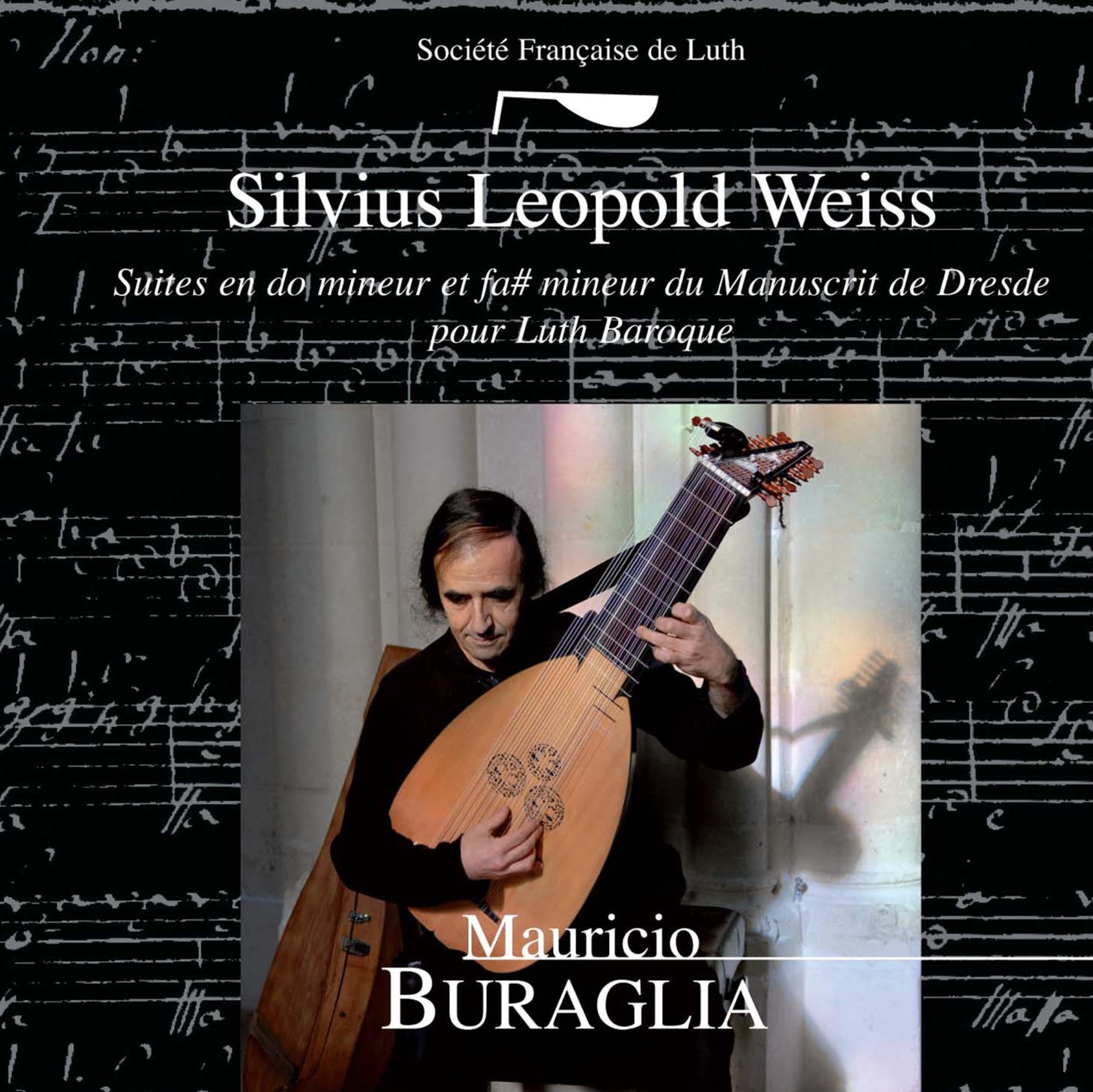
 Mauricio Buraglia : Suites en do mineur et fa mineur de Sylvius Leopold Weiss.
A marvelous classical spiral of lute sounds.
Silvius Leopold Weiss (1687-1750) was, according to his student Luise
Gottsched (the musically talented wife of the author and critic Johann
Christoph Gottsched) "the greatest lutenist that Europe had ever heard and
admired". What is clear is that his music is of an invention, depth, and virtuosity that neatly rounds out the final flowering of European lute composition,and is easily placed beside the music of Francesco Canova da Milano,
John Dowland, and Ennemond Gautier as being quintessentially vital to
the canonics of lute history.
Weiss was born in Grottkau (currently called "Grodkow" in Polish), a city
that was then the capital of the province of Silesia. He was taught the lute
by his father, Johann Jacob Weiss, who was himself a lutenist at the Palatine
Court. The young Silvius Leopold proved a prodigy, and played his first
royal performance before Emperor Leopold I at the tender age of seven.
Perhaps the most important moment of his development came in 1708, when
he went to Rome for a stay that would last six years as part of the musical
entourage of Prince Aleksander Sobieski. The contact that he doubtlessly
would have had during this period with Italian musicians such as Corelli,
the Scarlattis, and perhaps with Vivaldi in Venice, places him at the very
centre of the dynamic musical culture of his time. The traces of his Italian
sojourn can be heard very clearly in his music, which is the most successful
adaptation on the lute of the new cantabile style, a type of instrumental
composition based on the lyrical qualities of contemporary Italian opera.
In 1718, Weiss obtained the post of lutenist in Dresden at the court of August
"the Strong", who along with his successor Frederick the Great, gathered
some of the best-known musicians of the period, including Johann David
Heinechen, Pantaleon Hebenstreit, Johann Georg Pisendel, Francesco Maria
Veracini, Johann Joachim Quantz, Adolf Hasse and his wife Faustina
Bordoni. Not only was Weiss surrounded by such musical luminaries at
court, but in 1739, he is known to have stayed as a guest in the home
of J.S. Bach himself.
Weiss was to spend the rest of his life in Dresden - even refusing the incredible offer of an annual salary of 2000 Thaler from the Viennese court in 1736, presumably in order to remain part of the city's vibrant musical life. He
eventually became, in 1744, the highest-paid instrumentalist at the court
with a salary of 1400 Thaler. Perhaps it was due to his extraordinary talent
that one of the most incredible anecdotes of his life came to pass: in 1722,
a jealous violinist named Petit tried to end Weiss' brilliant career by biting
his thumb off! Luckily, Petit failed in his attempt, although Weiss' hand
was seriously wounded in the encounter. After several months of recuperation
and much speculation, Weiss was ultimately able to resume playing
and composing music such as we hear on the current recording.
Despite his success and high salary, when Weiss died he left almost nothing
to his family. Perhaps this has to do with the eleven children he had with
his wife, Maria Elizabeth, who he married at about the time of his
appointment in Dresden.
In 1750 seven of his children were still alive and his impoverished widow
appealed to the Elector for financial aid, eventually securing a position as
a nursery maid. Indeed, family fortunes do not seem to have improved.
Weiss' grandchildren would later ask the Dresden court to return to them
the great lutenist's theorbo, in order to sell it for a sum that would permit
them to buy firewood. Fortunately, the more than 600 pieces for the lute
that Weiss left behind provide an artistic legacy of unparalleled wealth
for modern connoisseurs of lute music.
Songs:
1. Ouverture (largo-allegro-vivace) (Sylvius Leopold Weiss)
2. Courante assai moderato en do mineur (Sylvius Leopold Weiss)
3. Bourree en do mineur (Sylvius Leopold Weiss)
4. Siciliana en do mineur (Sylvius Leopold Weiss)
5. Menuet en do mineur (Sylvius Leopold Weiss)
6. Presto en do mineur (Sylvius Leopold Weiss)
7. Prelude en fa mineur (Sylvius Leopold Weiss)
8. Allemande andante en fa mineur (Sylvius Leopold Weiss)
9. Courante en fa mineur (Sylvius Leopold Weiss)
10. Bourre en fa mineur (Sylvius Leopold Weiss)
11. Sarabande andante en fa mineur (Sylvius Leopold Weiss)
12. Menuet en fa mineur (Sylvius Leopold Weiss)
13. Presto en fa mineur (Sylvius Leopold Weiss)
Listen to: the entire album.
License A marvelous classical spiral of lute sounds by Mauricio Buraglia for your project.
Play the music of Mauricio Buraglia in your restaurant or store.
Release date: 05/01/2020
Mauricio Buraglia lives in Paris France
Tagged as: Classical, Baroque, Instrumental Classical, Composer: Sylvius Leopold Weiss, Lute
Recommended albums:- Renaissance Lute by Ed Durbrow: Renaissance lute music.
- Toccata - Touched by Alex McCartney: Reflective, historically-informed performance on the lute
- Tombeaux - A secular requiem by Richard MacKenzie: Virtuoso English Lutenist and Guitarist
- Elizabeth's Lutes by Alex McCartney: Reflective, historically-informed performance on the lute
- Fantasia Incantata by Ensemble Libro Primo: A fantastic classical violin and lute duo interpreting Baroque composers
- La Superbe by Thomas Walker: Lute music of 17th century France and Italy
- The Melodious Birde - Keyboard Music By William Byrd by Colin Booth: solo harpsichord music
- Patrons of the Lute by Daniel Shoskes: A feast of Baroque lute
- Weiss Undercover by Daniel Shoskes: A feast of Baroque lute
- Pasquale Pericoli - Sei Sonate a Violoncello e basso by Vito Paternoster: cellist extraordinaire
- L'Invenzione del violoncello romantico by Vito Paternoster: cellist extraordinaire
- Music of Fernando Sor by Daniel Estrem: colorful classical guitar
- Medieval Game by Aitua: dreamy and beautiful original compositions on classical guitar
Downloads:
- MP3: High quality MP3 variable-bit-rate files. Most people download these: they are audiophile files that play everywhere.
- ALAC: Perfect quality Apple Lossless format files. If you use iTunes or an iPod, get these. They're an exact audio copy of the original CD, and include the CD artwork and artist info. This is the same format as High Definition audio provided by the iTunes store.
- AAC: High quality Apple Audio Codec files. If you use iTunes or an iPod, these files sound great and include CD art and artist info. This is the standard format provided by the iTunes music store.
- WAV: Perfect quality WAV files. This format works everywhere, and is an exact audio copy of the original CD. It sounds fantastic. Album art and artist info is unfortunately not possible with this format.
- FLAC Perfect quality open source FLAC files. This is an open source audio format. It is an exact copy of the original CD, and includes CD artwork and artist info. Works great on Linux, VLC and many audio players based on open source.
- OGG: High quality open source OGG files. This is an open source audio format. It is a compressed (smaller file size) version of the original CD, and includes CD artwork and artist info. Works great on Linux, VLC and many audio players based on open source.
- 128k: Medium quality 128K MP3 files. These are medium audio quality MP3 files that will work on every device. The audio quality is good enough for most uses. These files are intended for cases where you want to conserve disk space.

![[Magnatune : we are not evil]](http://he3.magnatune.com/images/m3/inside_magnatune_logo.gif)
![[Free trial: only $15 per month]](http://he3.magnatune.com/images/m3/inside_mascot.gif)
![[login]](http://he3.magnatune.com/images/m3/login_btn.gif)
![[info]](http://he3.magnatune.com/images/m3/info_btn.gif)