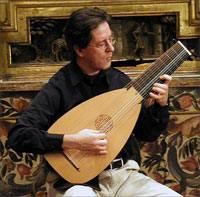
Paul Beier graduated from the Royal College of Music, London, under Diana
Poulton. He has performed throughout Europe, Australia, North and South America
with a solo repertoire extending from the early Sixteenth Century to the music
of Bach and Weiss. Founder and director of Ensemble Galilei, now renamed Galatea,
he also collaborates with many baroque music groups.
His CDs (9 solo lute recordings and 4 as director of Galatea) have been received
very well; some of them earned important recognition such as Disque du Mois of Rortoire,
5 Diapason, 5 stars of Goldberg, etc. Since 1981 he teaches Lute, Basso Continuo
and Renaissance Ensemble at the Civica Scuola di Musica (Accademia
Internazionale della Musica) in Milan.
Program Notes for "Michelagnolo Galilei: Sonate from Il primo libro d'Intavolatura
di liuto (1620)"
The age of the Counter Reformation, more than any other in the history of
civilization, was marked by a close connection between science and art, and the
birth of experimental method coincided with the most ardent experimentation in
the field of music. The ideal focal point in this unrepeatable confluence is
represented by the name of Galileo Galilei, whose musical disposition was
remarked by Viviani as follows:
"Amoung his most treasured entertainments were the practice of music and playing
upon the frets of the lute, in which, with the example and instruction of his
father, he came to such excellence, that he found himself in competition with
the best professors of the time in Florence and Pisa, being most rich of
invention on that instrument, and exceeding his father in gentleness and grace
of playing; he retained this suave style always even to his last days."
His father was the Vincenzo Galilei who contributed in such a decisive way to
the recovery of the music of the ancient Greeks and to the new style of
accompanied monody welcomed with enthusiasm in Florence at the end of the 16th-century.
Vincenzo transmitted the qualities of lute virtuoso to his children: besides the
first-born Galileo, the youngest child Michelagnolo was a lutenist. Born in
Florence the 18th of December 1575 (as recorded in a horoscope generated for his
brother by the famous scientist), the education of Michelagnolo was dedicated
from the very beginning to his training as a professional musician. At the age
of just nine years, in fact, he signed the dedication of a volume of
instructional compositions by his father, eloquent as to the type of study he
had already undertaken:
"My father having composed the present two-part Counterpoints a few days ago, so
that with them (after lessons of greater import that he has given me to study) I
could exercise the voice and the playing of the viola with the help of a solo,...
".
The death of Vincenzo in 1591 probably destroyed a secret plan to place his
musician son in the court of the Grand Duke. Thus Michelagnolo, sixteen years
old, had to be given into the custody of his older brother the scientist, and so
he joined Galileo in Padova; from this moment on the lives of the two brothers
were to be closely intertwined, if also problematic. Thanks to the vast
epistolary documentation compiled by Antonio Favario in his edition of the works
of Galileo (Florence 1890 - 1909), and to a few specialized studies (for example
the recent one by Claude Chavel in his introduction to the facsimilie edition of
Galilei's Primo Libro d'Intavolatura, (Minkoff, Geneva 1988), we can plausibly
reconstruct Michelagnolo's biography.
Galileo, then, was to materially direct the future life of his brother: after
having him come to Padova in 1592, he sent him off the following May to Poland,
surely in the train of some nobleman of those parts, possibly a student whose
acquaintance had been made in his Padovan studio. In 1599 Michelagnolo returned
to Italy; Galileo now tried to find, with the help of friends (particularly that
of Emilio del Cavaliere), an appointment for him at the Medici court, but
without success, due to the overabundance of musicians euphoric over the new
music-theater "teatro in musica" in Florence. Thus, Galileo had no choice but to
send his brother back to Poland in the summer of 1600, again in the service of "that
Polish gentleman in whose care Michelagnolo had been previously", this time,
however, with a very high salary, and every convenience. (His protector has
generally been identified as Prince Radziwill of Vilna, in Lithuania, but there
is no documentary confirmation of this.) Michelagnolo's son, Vincenzo, in his
turn also a lutenist, was to retain the connection with Poland; Michelagnolo,
however, was again in Padova in 1606: one can easily imagine the disappointment
of his brother. Galileo aimed higher this time, to the court of the Duke of
Bavaria in Munich, where Michelagnolo subsequently moved, definitively, in 1608.
There he married Anna Clara Bandinelli, who gave birth to seven children, of
whom Alberto Cesere, as well as the above mentioned Vincenzo, were to become
lutenists.
Galileo continued to procure lute strings for his brother from Florence "for his
use and his students", and satisfied the desire of the Duke of Bavaria, via his
brother, to obtain the scientist's latest books and that rarest of prizes, a
telescope. In 1620, Il Primo Libro d'Intavolatura di liuto di Michelagnolo
Galilei [. . .] Liutista del Ser.mo Sig.r Duca Massimiliano di Baviera appeared
in Munich, a collection of almost all of the surviving works of the author. (Excluded
are a few works scattered through printed anthologies and manuscripts, all of
Bavarian origin.) The frontispiece and the dedication are written in Italian (notice
of a contemporary version in German does not seem credible), which suggests the
possibility that Galilei might at first have intended to print the book in Italy,
or to dedicate it to an Italian prince. In point of fact, even before his first
departure to Poland Michelagnolo possesed a collection of his "sonate" which
were particularly appreciated in Florence, as seen in a letter, until now
overlooked by scholars, written to Galileo by his mother in 1593:
". . . [Michelagnolo] says that you gave certain sonate into the posession of I
know not which gentlemen, who sent here all the Princes asking for others
similar to the ones they have, the which he took badly, and doesn't want to give
them out anymore to anyone . . ."
The permanent appointment at Munich did not resolve the economic situation of
Michelagnolo's family, and until his death in 1631 he did not quit bothering his
brother, even up to their last encounter in Florence in 1628, with requests for
money and for help with his children. Of his two lutenist sons, both were sent
to Rome by the Duke of Bavaria to study the lute, theorbo, Italian and Latin;
Vincenzo ended his days in Poland, after having saddened and disappointed his
famous uncle, who became his guardian at the death of Michelagnolo; Alberto
Cesere took over his father's position as official lutenist to the court of
Munich until his death in 1692.
Until a few years ago only a single copy of the lute book printed by
Michelagnolo was known to have survived, that in the British Library in London,
originally owned by Albert Werl, author of a manuscript of the same period and
possibly a student of Galilei; a second copy has recently been found in Crakow,
a complete handwritten copy of the volume is the so-called "Pauer" manuscript.
The book of 1620 is very important for several reasons: first, the extraordinary
nature of a collection by an Italian author living abroad, written in "French"
tablature for a lute of ten courses; then, the presence of the most modern
compositional styles of the time, particularly evident in the durezze,
dissonances, in the Italian manner of Kapsperger, style brise and the exploration
of textural effects in the French style, and the still contrapuntal style as
found in Lorenzino or Piccinini. But then, this kaleidoscope of influences is in
fact the summation of the life work of the musician who, starting out in the
school of his father Vincenzo, must have proceeded through many encounters with
personages of the highest caliber: we think, for example, that his sons in Rome
were students of Kapsperger, of a lutenist in the service of Cardinal Ludovesi
who was probably Falconieri, and of a celebrated Parisian known as "Rene"
The collection presents twelve groups of compositions organized in ten different
modal groups, each composed, in the style of proto-suites, of an opening toccata
followed by one or more corrente and volte, with the addition of two gagliarda
in the first suite. At the end of the collection are two passemezzi in two parts
followed by saltarelli. Even at nearly four hundred years distance, the
collection reveals itself to modern listeners as a high artistic witness to a
period in the history of Italian and European music that is still, in good part,
waiting to be discovered.
- Dinko Fabris
Musician's notes for "Michelagnolo Galilei: Sonate from Il primo libro d'Intavolatura
di liuto (1620)"
We listen to the music of Michelagnolo Galilei entirely differently from the way
it was perceived in his day, and it is difficult, if not impossible, for us to
appreciate how a seventeenth century listener might have reacted upon hearing
what to him must have seemed radical and astonishing and to us appears but
delicate and rather subdued. That the ears of his public were not prepared for
what he offered them, that indeed they were more likely to be shocked or even
completely baffled, than to pleasantly and unquestioningly absorb the delicate
tones of his instrument, we can begin to infer from the address to the reader
with which Galilei introduces his only publication:
"...let him not think, finding in this work many harsh sounds [durezze] or
dissonances, that they are printing mistakes, for they must be left as they are;
and be assured that I have looked over the whole book meticulously many times
and I am certain that it is absolutely correct."
Can we really imagine with what incredulity the first pursuers of this book,
coming upon such, for them, wildly dissonant harmonies, tried to put right what
seemed better explained as a printing mistake than the will of a sane musician, in
an era in which, not so long ago, the very idea of such exposed "dissonance" as
found in Galilei went against the rules of music and of civilized taste.
The modern performer of the music of Michagnolo Galilei, while he might despair
of arousing in his listeners the amazement and disbelief Galilei must have
reserved for his, can only go so far as to try and recreate the auditory
conditions in which these emotions were once felt, within the limited scope of
his choice of instrument and presentation of the music itself. Galilei, all too
aware of the "difficult" nature of his music, tried in his preface to soften the
impact for the uninitiated by not only cautioning him about the unorthodox musical
content:
"Moreover, these, my sonate, might in part be found to be quite difficult,
speaking, as always, to those above mentioned novices: they could content
themselves, therefore, in the Correnti and Volte, to play the first and second
parts plain, repeating them, and leaving aside the diminutions; in so doing the
sonata will mot be made imperfect."
We are reminded here, in the question of diminutions (varied repeats of the
dance movements), that Galilei was forging a radical break from the traditional,
renaissance concept of passaggi, or florid melodic lines, to the frenzied,
almost chaotic style we now complacently refer to as "style-brise. In this sense,
modern listeners are well enough prepared for the shock, and the performer can
feel confident that not only will they appreciate the inclusion of Galilei's
sublime diminutions, they will not mind if we take up where the composer left
off...
As to the type of instrument most suitable to his music, Galilei has left some
indication: "... I say, therefore, to he who would like to play some of these my
little pieces, it is necessary that he has a lute of ten courses ...". While
this might lead us to consider, not without justification, the use of an Italian
arciliuto or arch-lute, such as was the rage at this time south of the Alps, we
would have to fit our arch-lute with just ten courses instead of the customary
thirteen or fourteen, a compromise not much in keeping with the extreme
qualities of Michagnolo and his music. Looking instead at the organological
environment of the expatriate's adopted home in Germany and, by extension,
France, we may find that the "French ten-course lute", that is, that species of
large early 16-century Italian lute, already surpassed by contemporary
instrument makers in Italy but highly treasured and regularly converted into ten-course
instruments by their transalpine contemporaries, is ideally suited to our
purposes.
The instrument I am proposing in this recording, then, is of modern construction,
but based on the design of an extant instrument, originally built by the
Bolognese maker Hans Frei sometime in the early sixteenth century, and converted,
probably in France, to a ten-course lute in the first decade or so of the
seventeenth century. The stringing is entirely in gut, but with some copper
reinforcement in lower basses. The musical temperament, as determined by the
unequal placement of the frets, is similar to that described in treatises for
the lute of the period.
- Paul Beier