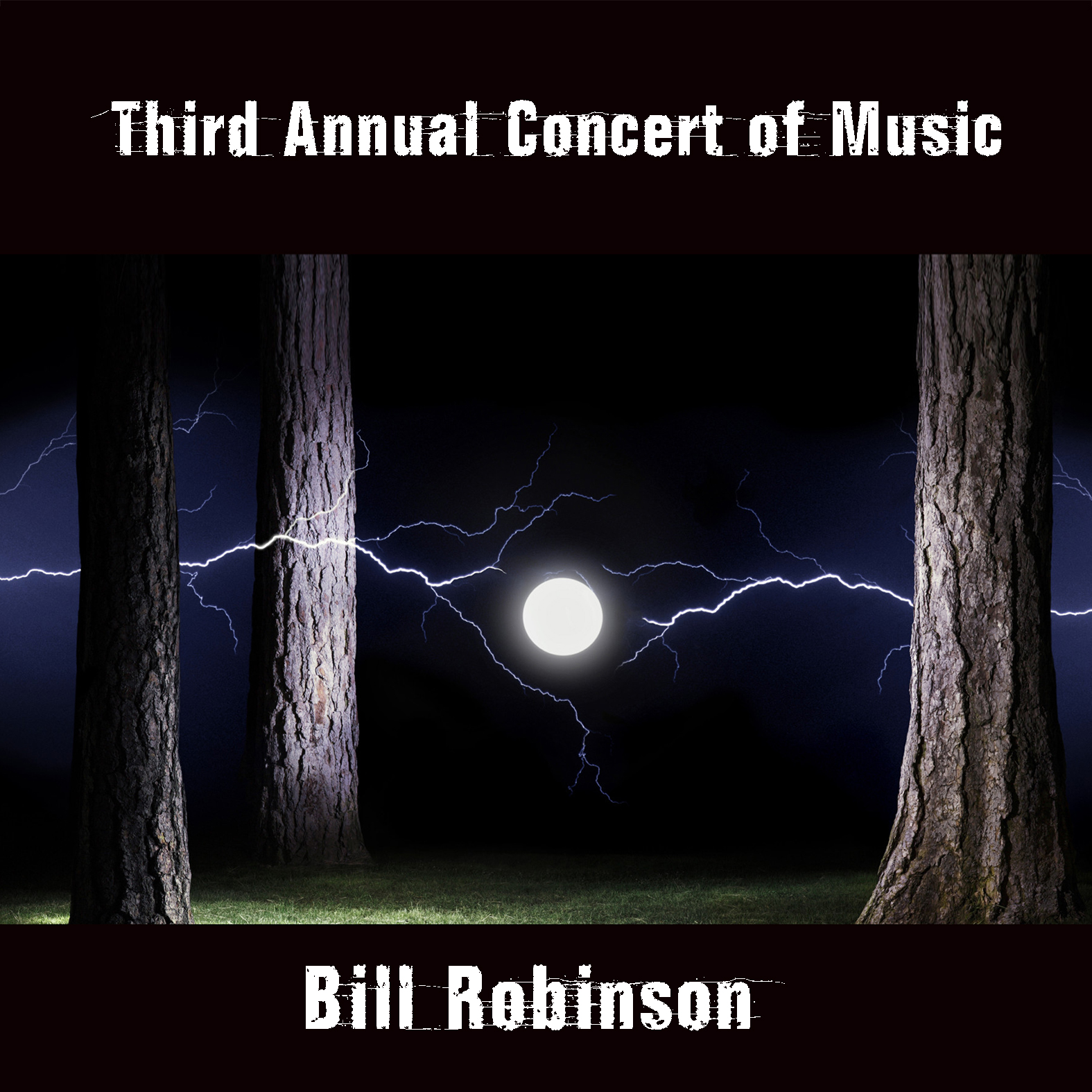
Bill Robinson : Third Annual Concert of Music.
New music in the classical context.
About Grand Serenade
Fred Jacobowitz asked me to consider writing something he could play with his
wife Bonnie Thron. He noted that there are several couples in the area of
clarinetists married to cellists, so it seemed like a very good idea. So, this
piece is dedicated to Fred and Bonnie. There were originally three movements,
but after the premiere Bonnie and Fred asked me to add a finale.
Any of the four movements can stand alone in performance; the first and last are
especially well-suited for this.
About Ananda Sonata
Ananda-Eric Pritchard asked me to write a violin sonata for his recitals early
in 2008, and as I had none in my catalog, it sounded like a very good idea. One
of my early compositions was a sonata for violin and piano, written during my
first year of college (1973 at Eastman), but it was immature and derivative and
has not survived. This work, on the other hand, is fully mature and ready for
consumption.
I'm not by nature a programmatic composer, so the first movement is not intended
to have a literal title; however I've had a pretty tough time much of my life
and in some way, a good deal of my music cannot help but reflect some of this.
After I had written most of the first movement that it seemed right to call it
"Hard Times". The second movement is intended as a kind of mantra; quite a few
of my works are best heard with a repeated series of words mentally set to the
music, and this is no exception. Since Ananda is involved with Sufism, it was
most appropriate to use Allah as the mantra. And the last movement started off
in 12 but then I knocked off a note leading to 11 per measure, then decided to
continue the prime number meter idea and ended up with most meters in 5, 7, 11,
and 13. In addition there are some fancy compound rhythms and some tricky
playing, especially for the piano. The technical requirements for the first
movement are moderate and the middle is easy, but the last movement does require
real proficiency. If this results in only the first or second movements, or
both, being performed at a future concert, this is perfectly acceptable.
About Clarinet Sextet
I have written two chamber works previous to this including clarinet;
Quartet for a New Beginning, for clarinet, violin, cello and piano, and
Grand Serenade. These combinations worked well for the kind of music that I
write. While most of my chamber music includes piano, sometimes I like to
get away from it for a bit. At first I intended to write a clarinet quintet
for the usual clarinet and string quartet, but from the first few measures
the music insisted on an extra cello. So-I went with the flow.
For no particular reason, the tempo markings are all taken from food. Except
for the first movement's "Adagio con queso", none give an idea as to tempo,
requiring musicians to refer to the metronome markings, which I much prefer.
Songs:
1. I Overture (Allegro) from Grand Serenade
2. II Romantic Interlude (Largo) from Grand Serenade
3. III Serious Scherzo (Capo di tutti Capi slow Trio Tempo I) from Grand Serenade
4. IV Grand Finale with Loose Canons (Allegro con brouhaha) from Grand Serenade
5. I Hard Times (Allegro non troppo) from Ananda Sonata
6. II Allah (Adagio alla mantra) from Ananda Sonata
7. III Prime Times (Eighly Eccentric) from Ananda Sonata
8. I A Small Still Voice (Adagio con queso) from Clarinet Sextet
9. II Faster Higher Louder (Paprika) from Clarinet Sextet
10. III Curious Interlude (Oregano I Oregano II) from Clarinet Sextet
11. IV A Fearful Earful (Gorgonzola) from Clarinet Sextet
Listen to: the entire album.
License New music in the classical context by Bill Robinson for your project.
Play the music of Bill Robinson in your restaurant or store.
Release date: 9/15/2016
Bill Robinson lives in North Carolina USA
Tagged as: Classical, Contemporary, Neoclassical, Instrumental, Cello, Clarinet, Classical Piano, Violin
Recommended albums:- The Melodious Birde - Keyboard Music By William Byrd by Colin Booth: solo harpsichord music
- Messe a l'usage des Couvents by Craig Hanson: exquisitely moving Baroque organ music
- A Solo Piano Christmas by Chad Lawson: Multi-award winning pianist and composer who is not afraid to put his hat in anything
- Vivaldi Concertos on 8-string guitar by Daniel Estrem: colorful classical guitar
- Toujours l'Amour by Music of the Spheres: small Baroque chamber ensemble
- Brian Bunker Trio by Brian Bunker Trio: A riotous romp through the worlds of jazz, classical and rock
- Ciaconna by Ernst Stolz: Renaissance and Baroque beautiful music revealed by Dutch gambist and multi-instrumentalist
- JS Bach Trios on Guitar by Daniel Estrem: colorful classical guitar
- In a Garden So Green, Lute Music of Scotland by Voices of Music: Lilting Renaissance & Baroque vocal interpretations
- Telemann Trios on Guitar by Daniel Estrem: colorful classical guitar
- Bach and His Teachers by Paul Boehnke: Heartfelt music for harpsichord
- The Dawn of Joy by Shira Kammen: early folk and celtic music.
- Louis Couperin Harpsichord Music by Colin Booth: solo harpsichord music
- Amazing Grace by David Modica: layers of lush acoustic guitar
- The Water is Wide by David Modica: layers of lush acoustic guitar
- Cerulean Blue by Robert Otto: Ambient Electronic and Neoclassical Soundscapes
- Tau Ceti by Robert Otto: Ambient Electronic and Neoclassical Soundscapes
- Around the World by Monom: ethnotronica, World music, electronic, downtempo, ambient techno, dystopia, cinematic, far-east, Australia and Europe
- Telemann on Guitar by Daniel Estrem: colorful classical guitar
- Vol 1 - Well Tempered Clavier Book 2 'Flat Keys' by Katherine Roberts Perl: Bach on the harpsichord - poetic and expressive
Downloads:
- MP3: High quality MP3 variable-bit-rate files. Most people download these: they are audiophile files that play everywhere.
- ALAC: Perfect quality Apple Lossless format files. If you use iTunes or an iPod, get these. They're an exact audio copy of the original CD, and include the CD artwork and artist info. This is the same format as High Definition audio provided by the iTunes store.
- AAC: High quality Apple Audio Codec files. If you use iTunes or an iPod, these files sound great and include CD art and artist info. This is the standard format provided by the iTunes music store.
- WAV: Perfect quality WAV files. This format works everywhere, and is an exact audio copy of the original CD. It sounds fantastic. Album art and artist info is unfortunately not possible with this format.
- FLAC Perfect quality open source FLAC files. This is an open source audio format. It is an exact copy of the original CD, and includes CD artwork and artist info. Works great on Linux, VLC and many audio players based on open source.
- OGG: High quality open source OGG files. This is an open source audio format. It is a compressed (smaller file size) version of the original CD, and includes CD artwork and artist info. Works great on Linux, VLC and many audio players based on open source.
- 128k: Medium quality 128K MP3 files. These are medium audio quality MP3 files that will work on every device. The audio quality is good enough for most uses. These files are intended for cases where you want to conserve disk space.

![[Magnatune : we are not evil]](http://he3.magnatune.com/images/m3/inside_magnatune_logo.gif)
![[Free trial: only $15 per month]](http://he3.magnatune.com/images/m3/inside_mascot.gif)
![[login]](http://he3.magnatune.com/images/m3/login_btn.gif)
![[info]](http://he3.magnatune.com/images/m3/info_btn.gif)