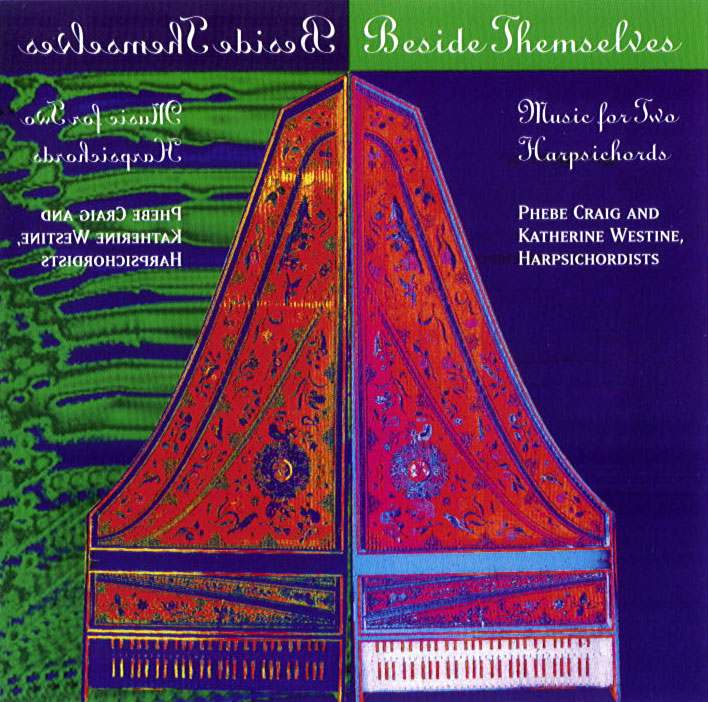
 Phebe Craig and Katherine Westine : Beside Themselves.
Harpsichord duets.
Rome, 1709. What happened after the great contest? Most lovers of harpsichord lore are familiar with the famous meeting of George Frideric Handel and Domenico Scarlatti where their host, Cardinal Ottoboni, set them to a contest of skill on both harpsichord and organ. When the guests had sufficiently recovered from this audiofest, they generally found Scarlatti to excel on the harpsichord, while Handel was the clear winner on the organ. The two musicians instantly developed a mutual esteem, and their friendship lasted throughout Handel's residence in Rome.
Did the two keyboard virtuosi ever get together long enough to tune two harpsichords to each other (not for the faint-hearted) and play duets? Or were they condemned always to the polarities of the harpsichordist; that is, the lofty, but lonely, prominence of the soloist, or the supportive, self-effacing role of the continuo player? History (like our news media) tends to concentrate on incidents charged with dramatic conflict, so we must become historical novelists to picture happy afternoons with Handel and Scarlatti entertaining a few choice friends and patrons with the bristling excitement that can only be generated by two harpsichords exchanging tunes.
Napa Valley, California, 1993. Enter Katherine Westine and Phebe Craig, beside themselves with a shared vision to breathe new life into a genre both delicate and robust. Phebe Craig and Katherine Westine not only recreate old treasures, but also apply their baroque sensibilities to the works of modern composers. Armed with two Italian and two French harpsichords, Westine and Craig explore the acoustics of a converted 19th century winery (complete with bats). On this recording you will hear the Italian harpsichords for the music of J.S. Bach and Scott Joplin, and the French harpsichords for the remaining selections. The astute listener will quickly notice the distinct character of each instrument, a property of harpsichords which, in contrast to modern keyboard instruments, provides enormous satisfaction to the connoisseur.
The musical selections. In 1789, Charles Burney wrote that Wilhelm Friedemann Bach (1710-1784) 'was the best organist in Germany, in style, fancy and knowledge of harmony...particularly in the use of pedals.' Apparently W.F. Bach was not widely recognized as a composer in his own time, but his surviving music demonstrates a unique personality. This son of the great J.S. Bach seemed to enjoy straddling the esthetic fence between baroque and rococo, especially in the Concerto in F Major for Two Harpsichords. The first movement is a fine example of early classical sonata form, while the second and third movements make a comfortable return to baroque concerto style.
Absorption of local color into formal music is also a feature of Antonio Soler (1729-1783), in the tradition of his teacher, Domenico Scarlatti. Soler wrote six concerti for two organs 'for the diversion' of his young pupil, 'the most Serene Infante Don Gabriel de Borbon,' favorite son of Carlos III. It is likely that these concerti were written for performance on two small, similar organs which stood in the little theater at El Escorial. The Concierto II heard on this recording is saturated with Spanish flavor (saffron, pimiento, sangria, sherry) and the listener can easily discern a Spanish guitar style in the energetic plucking of the two harpsichords. Impressionable listeners might detect the fragrance of a rose on a sultry evening.
A master of the French baroque style, Francois Couperin (1668-1733) shared the enthusiasm of his contemporaries for the folk dance tunes and rhythms associated with bagpipe and hurdy-gurdy music. Numerous stage productions of this period feature musetes complete with singing, dancing, and orchestra enhanced by specialized instruments. With his Musetes de Choisi et de Taverni, Couperin reaches back to his family roots and refashions folk music from the towns of Choisi and Taverny to chamber music for the court of Louis XIV, the Sun King.
Johann Sebastian Bach (1685-1750) was frequently inspired to create extravagantly tuneful works for multiple harpsichords, occasionally transforming music from other sources to endow them with new expression on plucked keyboards.
J. S. Bach's concerti were often performed at Zimmermann's coffee house in Leipzig, often with the participation of his sons Carl
Philipp Emanuel and Wilhelm Friedemann. (We are not aware of any scholarly studies associating the high energy of the Bach family
concerti with the influence of coffee.)
The Concerto in C Major for Two Harpsichords is an outstanding example of the mature baroque concerto; while conforming to a standard three-movement concerto structure, its polyphonic richness goes far beyond the formulas of a mere occasional concerto.
With the Stoptime Rag of Scott Joplin (1868-1917). Westine and Craig present a significant historical event: the first interactive harpsichord CD. In the original publication of this charming dance, the composer annotated the downbeats with the word 'Stamp' to indicate that this piece is not complete without some percussive footwork. Gentle listener, kindly stamp one of your feet with your heel to propel this tuneful ditty on its way. Improvised toe-tapping may be added to taste.
Songs:
1. Wilhelm Friedemann Bach- Concerto in F Major for 2 Harpsichords (Allegro moderato)
2. Wilhelm Friedemann Bach- Concerto in F Major for 2 Harpsichords (Andante)
3. Wilhelm Friedemann Bach- Concerto in F Major for 2 Harpsichords (Presto)
4. Antonio Soler- Conceierto II in a minor (Andante)
5. Antonio Soler- Conceierto II in a minor (Allegro)
6. Antonio Soler- Conceierto II in a minor (Tempo de Minue)
7. Francois Couperin- Musetes de Choisi et de Taverni
8. Johann Sebastian Bach- Concerto in C Major for 2 Harpsichords (Allegro moderato)
9. Johann Sebastian Bach- Concerto in C Major for 2 Harpsichords (Adagio ovvero Largo)
10. Johann Sebastian Bach- Concerto in C Major for 2 Harpsichords (Allegro)
11. Scott Joplin- Stoptime Rag
Listen to: the entire album.
License Harpsichord duets by Phebe Craig and Katherine Westine for your project.
Play the music of Phebe Craig and Katherine Westine in your restaurant or store.
Release date: 10/5/2004
Phebe Craig and Katherine Westine lives in California USA
Tagged as: Classical, Chamber Music, Baroque, Classical Period, Instrumental, Composer: Antonio Soler, Composer: Francois Couperin, Composer: Johann Sebastian Bach, Composer: Wilhelm Friedemann Bach, Harpsichord
Recommended albums:- Song Surf - Magic Forest by Angelight: New Age/World Music for mankind from Russia
- Looking for a Way Out by Paolo Pavan: Urban funky jazz piano, in a sober and straightforward style
- Tantrabeats 1 - The Space of the Body by Angelight: New Age/World Music for mankind from Russia
- Up by Paolo Pavan: Urban funky jazz piano, in a sober and straightforward style
- The Intervention by Anonymous Culture: stylish and sharp witted hip-hop
- Velvet Face by Paolo Pavan: Urban funky jazz piano, in a sober and straightforward style
- Too Much Mustard by Professor Armchair: demented 19th century children's music
- Les Baricades Misterieuses by Hanneke van Proosdij: vibrant harpsichord-music
- Somewhere New by Andre Rodriguez: melodic rock combining memorable melodies with thoughtful storytelling
- Harpsichord suites of Chambonnieres by Hanneke van Proosdij: vibrant harpsichord-music
- The Twisting of the Rope by Aryeh Frankfurter: Timeless and enchanting folk music for the soul
- The Cure for Chaos Theory by Psycliq: an electric heart with an organic soul
- In Their Footsteps by Aryeh Frankfurter: Timeless and enchanting folk music for the soul
- Public Service Announcement by The Proper Authorities: pulse-pounding, booty-shaking rock
- Le Souvenir de Vous me Tue by Asteria: late-medieval vocal and instrumental music
- Public Service Announcement (Instrumental) by The Proper Authorities: pulse-pounding, booty-shaking rock
- Magic Season by Ash Ganley: masterfully nuanced AAA rock
- Determination by Quantum Milkshake: A surreal, soundtrack-inspired, dance band
- The All Seeing Eye Project by Ambient Teknology: upbeat underground with shades of new wave
- Back Home by The Ranchhands: Fiddle driven modern country music
Downloads:
- MP3: High quality MP3 variable-bit-rate files. Most people download these: they are audiophile files that play everywhere.
- ALAC: Perfect quality Apple Lossless format files. If you use iTunes or an iPod, get these. They're an exact audio copy of the original CD, and include the CD artwork and artist info. This is the same format as High Definition audio provided by the iTunes store.
- AAC: High quality Apple Audio Codec files. If you use iTunes or an iPod, these files sound great and include CD art and artist info. This is the standard format provided by the iTunes music store.
- WAV: Perfect quality WAV files. This format works everywhere, and is an exact audio copy of the original CD. It sounds fantastic. Album art and artist info is unfortunately not possible with this format.
- FLAC Perfect quality open source FLAC files. This is an open source audio format. It is an exact copy of the original CD, and includes CD artwork and artist info. Works great on Linux, VLC and many audio players based on open source.
- OGG: High quality open source OGG files. This is an open source audio format. It is a compressed (smaller file size) version of the original CD, and includes CD artwork and artist info. Works great on Linux, VLC and many audio players based on open source.
- 128k: Medium quality 128K MP3 files. These are medium audio quality MP3 files that will work on every device. The audio quality is good enough for most uses. These files are intended for cases where you want to conserve disk space.

![[Magnatune : we are not evil]](http://he3.magnatune.com/images/m3/inside_magnatune_logo.gif)
![[Free trial: only $15 per month]](http://he3.magnatune.com/images/m3/inside_mascot.gif)
![[login]](http://he3.magnatune.com/images/m3/login_btn.gif)
![[info]](http://he3.magnatune.com/images/m3/info_btn.gif)