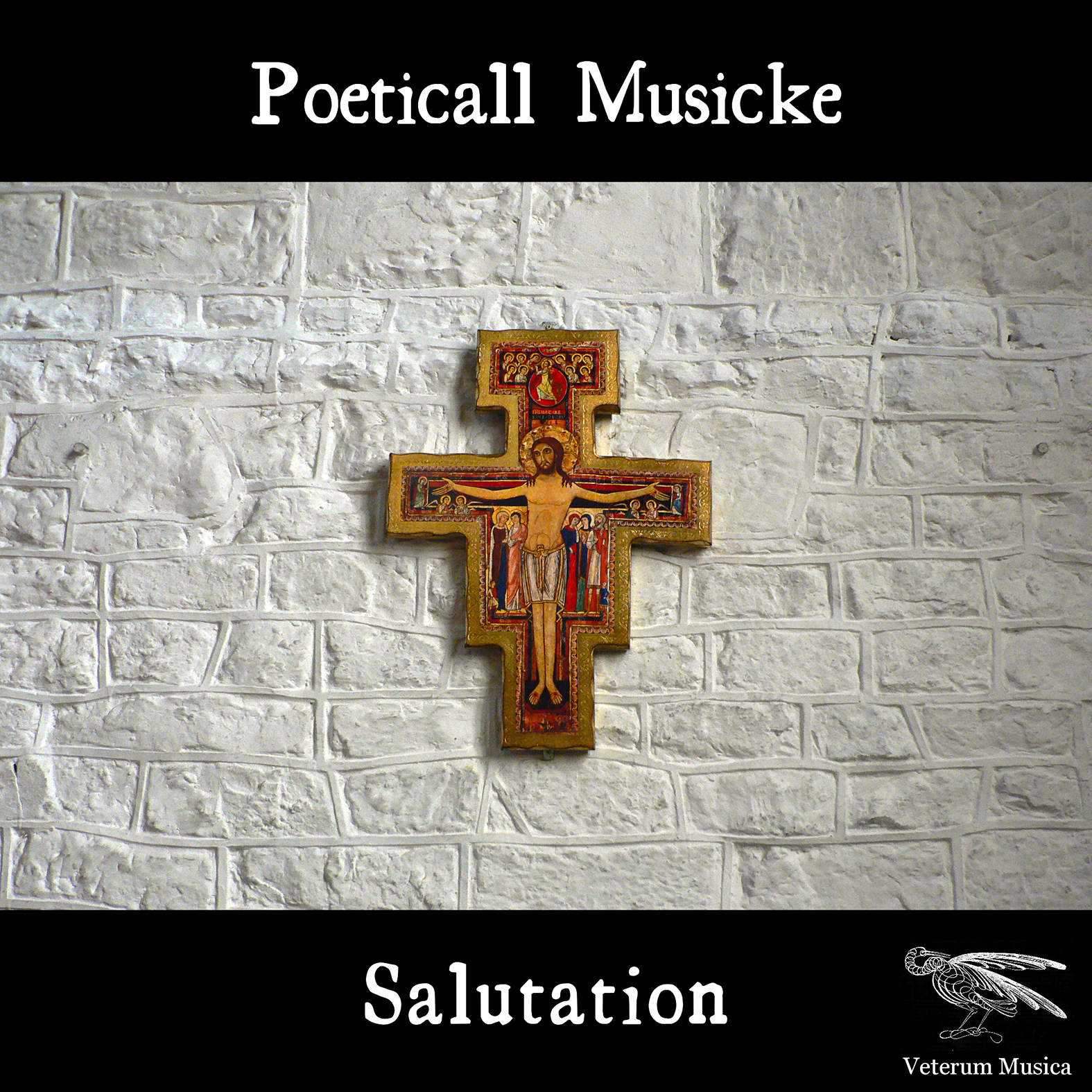
Poeticall Musicke : Salutation.
Late renaissance and early baroque music, historically performed.
Together, Heinrich Ignaz Franz Biber von Bibern (1644 - 1704) and Johann Jakob
Walther (1650 - 1717) are possibly the most significant composer-violinists of
the late 17th century. Both wrote music for a virtuoso technique including the
extensive use of doublestops and arpeggios, their works also display a wealth of
formal compositional devices.
All the known facts of Walther's life and activity are from the Musikalischen
Lexikon (a dictionary from 1732) by Johann Gottfried Walther (Johann Sebastian
Bach's cousin). J.J. Walther was born in Witterda bei Erfurt. Between 1670 and
1674 he is said to have been employed as a violinist in the orchestra of Cosimo
III of the Medicis in Florence. From 1674 he was concertmaster at the court of
Dresden. After the death of his patron, John George II, in 1680 he became the
Italian secretary at the elector's court in Mainz, where he would remain until
his death.
Biber was born in the small Bohemian town of Wartenberg, Biber worked at Graz
before he illegally left his Kremsier employer (Prince-Bishop Carl-
Liechtenstein-Castelcorno) and settled in Salzburg. He remained there for the
rest of his life, publishing much of his music but apparently seldom, if ever,
giving concert tours.
Dieterich Buxtehude (1637/39 - 1707) was a Danish-German organist and composer.
His organ works represent a central part of the standard modern organ
repertoire. He composed in a wide variety of vocal and instrumental idioms; his
style strongly influenced many composers, including Johann Sebastian Bach.
Buxtehude's last post, from 1668, was at the Marienkirche, Lübeck which had two
organs, a large one for big services and a small one for devotionals and
funerals. There he succeeded Franz Tunder and (following in the footsteps of his
predecessor) married Tunder's daughter Anna Margarethe in 1668 - it was a common
practice! Buxtehude and Anna Margarethe had seven daughters who were all
baptized at the Marienkirche.
Songs:
1. Hortulus Chelicus IV (Johann Jacob Walther)
2. The Annunciation (Heinrich Ignaz Franz Biber von Bibern)
3. Suite in F (Dietrich Buxtehude)
4. Sonata I in F (vn vl bc) (Dietrich Buxtehude)
5. Sonata IV in Bb (vn vl bc) (Dietrich Buxtehude)
6. Suite in G (Dietrich Buxtehude)
7. Sonata in G (2 vn vl bc) (Dietrich Buxtehude)
Listen to: the entire album.
License Late renaissance and early baroque music, historically performed by Poeticall Musicke for your project.
Play the music of Poeticall Musicke in your restaurant or store.
Release date: 04/05/2016
Poeticall Musicke lives in York England
Tagged as: Classical, Baroque, Chamber Music, Instrumental, Composer: Dietrich Buxtehude, Composer: Heinrich Ignaz Franz Biber von Bibern, Harpsichord, Recorder, Viola da Gamba
Recommended albums:- Commusicare by Commusicare: musical conversation from the Renaissance to the Baroque
- Soyes Loyal by Asteria: late-medieval vocal and instrumental music
- Chopin Preludes for Piano by Eric Zivian: virtuoso fortepianist plays Chopin
- Hidden Sky by Jami Sieber: enchanting cello compositions
- Where What Where by Attic Trax: Chilled downtempo with a bit of attitude
- Viva La Pepa by Viva La Pepa: Spanish, Sephardic and French traditions served on a bed of drones
- German music for Viols and Harpsichord by Les Filles de Sainte Colombe: viol & harpsichord music
- The In Between by Anton Cosmo: rock superstar to be
- Backwoods Chaos by Mark Cook: blues guitar legend in the making
- Life in Reverse by Almer and Nirvan: soulful Balkan duo featuring acoustic guitars and voice
- Askold Buk by Askold Buk: guitar-driven, groove-oriented feel-good jazz/r&b tunes
- 8 by Barks and Crock: Berlin based electronic music - from ambient atmospheric to dance
- Broken Poets by Broken Poets: indie rock when lyrics were king
- Another Ride by Chad Farran: an impressive journey through Latin rhythms and moves
- Always About You by Chiwawa: He who sings thinks no evil
- Dark Transport by Charlie Beresford: beautifully, dark, acoustic progressive
- My Little Book, Tome 1 by Francois Couture: Canadian composer, musician, orchestrator, arranger and sound designer
- Hang by Laura Inserra: the Hang, a new instrument from Switzerland
- By the Sea by Geoff Cawthorn: solo piano works
- Native Unit by Eric Kamen: Urban Flamenco
Downloads:
- MP3: High quality MP3 variable-bit-rate files. Most people download these: they are audiophile files that play everywhere.
- ALAC: Perfect quality Apple Lossless format files. If you use iTunes or an iPod, get these. They're an exact audio copy of the original CD, and include the CD artwork and artist info. This is the same format as High Definition audio provided by the iTunes store.
- AAC: High quality Apple Audio Codec files. If you use iTunes or an iPod, these files sound great and include CD art and artist info. This is the standard format provided by the iTunes music store.
- WAV: Perfect quality WAV files. This format works everywhere, and is an exact audio copy of the original CD. It sounds fantastic. Album art and artist info is unfortunately not possible with this format.
- FLAC Perfect quality open source FLAC files. This is an open source audio format. It is an exact copy of the original CD, and includes CD artwork and artist info. Works great on Linux, VLC and many audio players based on open source.
- OGG: High quality open source OGG files. This is an open source audio format. It is a compressed (smaller file size) version of the original CD, and includes CD artwork and artist info. Works great on Linux, VLC and many audio players based on open source.
- 128k: Medium quality 128K MP3 files. These are medium audio quality MP3 files that will work on every device. The audio quality is good enough for most uses. These files are intended for cases where you want to conserve disk space.

![[Magnatune : we are not evil]](http://he3.magnatune.com/images/m3/inside_magnatune_logo.gif)
![[Free trial: only $15 per month]](http://he3.magnatune.com/images/m3/inside_mascot.gif)
![[login]](http://he3.magnatune.com/images/m3/login_btn.gif)
![[info]](http://he3.magnatune.com/images/m3/info_btn.gif)