 SCD : Biber Violin Sonatas.
Baroque trio.
One outcome of the Catholic Counter-Reformation of the 16th and 17th centuries was a new movement in Roman Catholic mysticism. For a circle of religious writers, of whom the Spanish St. Teresa of Avila (1515-1582) is the best known, the goal was to illuminate the mysteries of the faith and create an emotional state of mind open to the mystical experience. El Greco (1541-1614) translated this movement into painting, taking as his subjects moments of mystical apotheosis and depicting them in an otherworldly and ecstatic style. And Heinrich Ignaz Franz Biber (1644-1704) created this same emotional state of mind through the transcendent mysticism of him music.
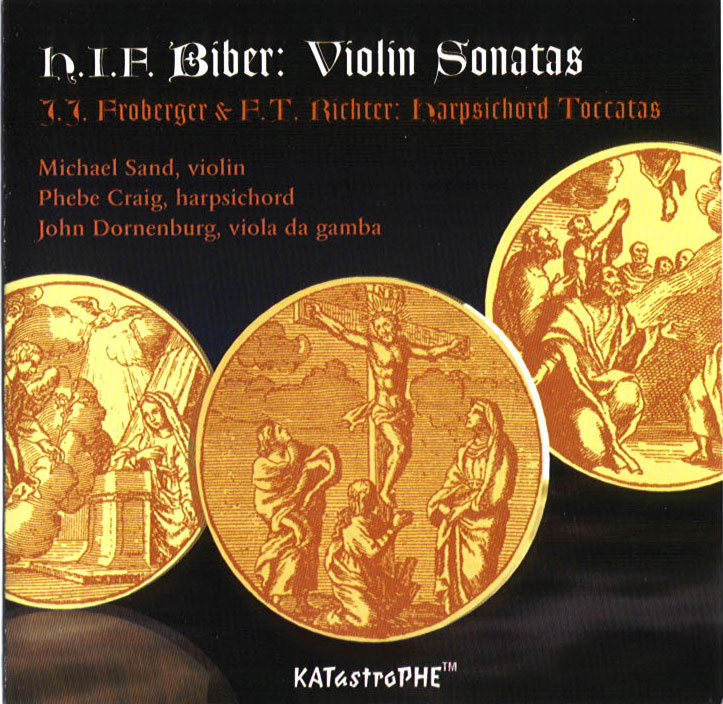
The outstanding non-Italian violinist of the century, Biber was born in Bohemia of German descent. He went first into the service of Count Liechtenstein-Kastelkorn of Olomouc, then entered the chapel of the Archbishop of Salzburg, where he remained for the rest of his life, rising to the posts of Kapellmeister and Dean of the Choirboy School. In 1681, Biber published a volume of eight sonatas in Nuremberg including the Sonata No. 6 in C minor which opens this recording. His 15 Mystery or Rosary Sonatas, dating from about 1676, were not published; they survive in an ornate manuscript, in which each sonata is preceded by an engraving depicting an event in the life of Jesus or Mary. (Some of these medallions are reproduced on the cover of this CD.) It is possible that these pieces were meant for performance as postludes for October services at Salzburg Cathedral: October 7 is the Feast of the Rosary. Biber's reputation as a violinist survived into the late 18th century, when the English historian Charles Burney described him thus: "...of all the violin players of the last century, Biber seems to have been the best, and his solos are the most difficult and most fanciful of any music I have seen of the same period." In addition to solo violin music, Biber composed operas and other dramatic works, sacred vocal music, and instrumental music for ensembles of various types.
Though not as influential as Corelli, whose sonatas became the universal model, Biber's compositions for violin are the work of a master who fully understood the technical and expressive possibilities of his instrument and had a flair for highly descriptive music. But the technique with which Biber is most strongly associated is the device known as scordatura. Scordatura, the Italian word for 'mistuning,' means that the violin is tuned in ways other than the standard fifths: G D A E. It is originally a folk fiddling device, and folk fiddlers all over the world use standard scordatura tunings such as A D A D or G C G C as a way to gear the violin towards a specific key and make the double-stops easier.
Of the 15 sonatas in the Rosary collection, only Sonata 1, The Annunciation, uses the standard violin tuning. The other 14 are all in scordatura. Some of the scordaturas require the change of only a single string, such as the G D A D used in The Crucifixion, but some require the change of three strings, like The Assumption of Mary -- A E A D, or even all four, like The Ascension, tuned C E G C.
Interestingly, the c minor sonata from 1681 begins in the standard tuning, but requires the performer to retune his E string down to D halfway through! This retuning is followed by a Gavotte with variations which, despite the French origin of the dance, retains a definite flavor of Bohemian folk music.
But Biber's use of scordatura goes far deeper than being a means of facilitating double-stops. (They are almost impossible in the standard tuning.) For a more important effect of scordatura is to endow the violin with maximum resonance in one specific key, which both narrows the focus of the violin's 'voice' and deepens its emotional impact. Each retuning changes the violin's sonority--to an almost mystical extent--and give the player a sense of playing on a new and different instrument.
The Rosary Sonatas are not program music in the 19th-century sense, like the tone poems of Richard Strauss. They are a manifestation of Roman Catholic mysticism, and as such their goal is to personalize the believer's relationship with Christ through meditation on his life and suffering. Just as each of the 15 beads of the rosary represents an event in the New Testament story, each of the Rosary Sonatas represents a meditation on that event.
Some of Biber's musical imagery is specific and graphic, most noticeably in The Crucifixion, where the three notes in the opening measure represent making the sign of the cross (both visually, on the page, and in action, as the violinist bows them), while the rhythm of the dotted triplets in the measure which follows represents both the word "kreu-zi-ge" -- crucify -- and the sound of the hammer striking the nails. Bach used the same dotted triplets to set "kreuzige" in the St. John Passion.
Similarly Christ's entrance into heaven in The Ascension is royally heralded by trumpet calls and stately marches. But sometimes Biber's imagery is merely emotive, like the joyful gigue that concludes The Assumption of Mary, a tune similar in appeal to an Irish gig accompanying Mary as she dances off to heaven at the end of her earthly life. Few composers have accomplished the non-linear and almost trance-like quality that marks much of Biber's music, particularly in the quasi-fantasia preludiums that open The Annunciation, The Crucifixion, and The Assumption of Mary. In our own time, perhaps only Messaien has come close.
As a transition between the four Rosary Sonatas on this recording, each is preceded by a keyboard fantasia in the same rhapsodic style. These interludes are highly representative of the period, for the 17th century saw an explosion of composition for organ, harpsichord and clavichord in German-speaking area. Johann Jacob Froberger (1616-1667) is perhaps the most important German keyboard composer before Bach. He was born in Stuttgart, and by 1637 had become organist at the Viennese Imperial Court. His patron, Emperor Ferdinand III, loved Italian culture, and helped make possible Froberger's 1640-41 study in Rome with Girolamo Frescobaldi (1583-1643), then a leading light of keyboard music in Europe. Froberger remained influential on German composers until well into the 18th century. Ferdinand Tobias Richter (1651-1711) was also an organists at the imperial court, working there from 1683 until his death. Richter's compositions show a flair for the dramatic to be expected from a composer who wrote a great deal of music for use in Jesuit schools.
Songs:
1. Sonata 6 in C Minor (from 8 Sonatas 1681 : Heinrich Ignaz Franz Biber von Bibern)
2. Toccata VI in A Minor 1656 (Johann Jakob Froberger)
3. Rosary Sonata 1 in D Minor The Annunciation (Heinrich Ignaz Franz Biber von Bibern)
4. Richter- Toccatina and Capriccio in D Minor (Ferdinand Tobias Richter)
5. Rosay Sonata 10 in G Minor The Crucifixion (Heinrich Ignaz Franz Biber von Bibern)
6. Toccata III in C Major 1656 (Johann Jakob Froberger)
7. Rosary Sonata 12 in C Major The Ascension (Heinrich Ignaz Franz Biber von Bibern)
8. Toccata IV in F Major 1656 (Johann Jakob Froberger)
9. Rosary Sonata 14 in D Major The Assumption of Mary (Heinrich Ignaz Franz Biber von Bibern)
Listen to: the entire album.
License Baroque trio by SCD for your project.
Play the music of SCD in your restaurant or store.
Release date: 10/5/2004
SCD lives in California USA
Tagged as: Classical, Chamber Music, Baroque, Instrumental, Composer: Ferdinand Tobias Richter, Composer: Heinrich Ignaz Franz Biber von Bibern, Composer: Johann Jakob Froberger, Harpsichord, Viola da Gamba, Violin
Recommended albums:- The Melodious Birde - Keyboard Music By William Byrd by Colin Booth: solo harpsichord music
- Messe a l'usage des Couvents by Craig Hanson: exquisitely moving Baroque organ music
- A Solo Piano Christmas by Chad Lawson: Multi-award winning pianist and composer who is not afraid to put his hat in anything
- Vivaldi Concertos on 8-string guitar by Daniel Estrem: colorful classical guitar
- Toujours l'Amour by Music of the Spheres: small Baroque chamber ensemble
- Brian Bunker Trio by Brian Bunker Trio: A riotous romp through the worlds of jazz, classical and rock
- Ciaconna by Ernst Stolz: Renaissance and Baroque beautiful music revealed by Dutch gambist and multi-instrumentalist
- JS Bach Trios on Guitar by Daniel Estrem: colorful classical guitar
- In a Garden So Green, Lute Music of Scotland by Voices of Music: Lilting Renaissance & Baroque vocal interpretations
- Classical Ukulele Volume 2 by Daniel Estrem: colorful classical guitar
- Enchanten by Margaret Maria Tobolowska: Sweeping new age cello
- Telemann Trios on Guitar by Daniel Estrem: colorful classical guitar
- Bach and His Teachers by Paul Boehnke: Heartfelt music for harpsichord
- The Dawn of Joy by Shira Kammen: early folk and celtic music.
- Jeremiah Lawson Vol 1 Preludes and Fugues by Daniel Estrem: colorful classical guitar
- Reicha Fugues on Guitar by Daniel Estrem: colorful classical guitar
- Sylvius Leopold Weiss Suites en si Bemol et la Majeur by Mauricio Buraglia: a marvelous classical spiral of lute sounds
- Stile Moderno, Stile Antico by Thomas Walker: Lute music of 17th century France and Italy
- Dreaming in Real TIme by David Modica: layers of lush acoustic guitar
- Seraphim by David Modica: layers of lush acoustic guitar
Downloads:
- MP3: High quality MP3 variable-bit-rate files. Most people download these: they are audiophile files that play everywhere.
- ALAC: Perfect quality Apple Lossless format files. If you use iTunes or an iPod, get these. They're an exact audio copy of the original CD, and include the CD artwork and artist info. This is the same format as High Definition audio provided by the iTunes store.
- AAC: High quality Apple Audio Codec files. If you use iTunes or an iPod, these files sound great and include CD art and artist info. This is the standard format provided by the iTunes music store.
- WAV: Perfect quality WAV files. This format works everywhere, and is an exact audio copy of the original CD. It sounds fantastic. Album art and artist info is unfortunately not possible with this format.
- FLAC Perfect quality open source FLAC files. This is an open source audio format. It is an exact copy of the original CD, and includes CD artwork and artist info. Works great on Linux, VLC and many audio players based on open source.
- OGG: High quality open source OGG files. This is an open source audio format. It is a compressed (smaller file size) version of the original CD, and includes CD artwork and artist info. Works great on Linux, VLC and many audio players based on open source.
- 128k: Medium quality 128K MP3 files. These are medium audio quality MP3 files that will work on every device. The audio quality is good enough for most uses. These files are intended for cases where you want to conserve disk space.

![[Magnatune : we are not evil]](http://he3.magnatune.com/images/m3/inside_magnatune_logo.gif)
![[Free trial: only $15 per month]](http://he3.magnatune.com/images/m3/inside_mascot.gif)
![[login]](http://he3.magnatune.com/images/m3/login_btn.gif)
![[info]](http://he3.magnatune.com/images/m3/info_btn.gif)