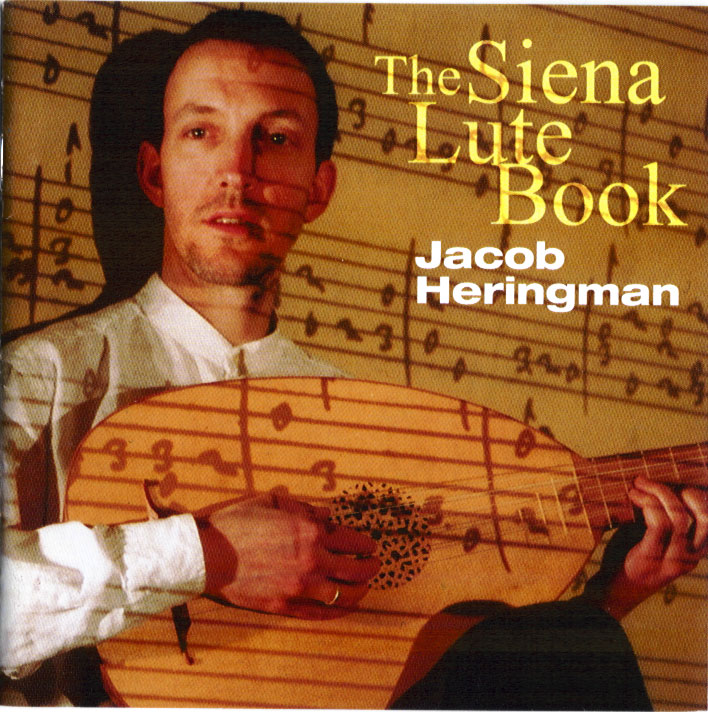
 Jacob Heringman : Siena Lute Book.
Renaissance lute. The works on the present recording have been selected from the contents of two manuscripts produced in Tuscany during the late sixteenth century. The sources are largely the work of a single scribe whose name has been lost to us. While originating from the same hand, they are different from one another in important ways. The "Siena Lute Book" (The Hague, Gemeentemuseum, MS 28.B.39) is a lengthy anthology of over 150 items that was compiled in Siena. Its highly organized layout suggests careful planning and that it may have been assembled as a preservation copy, a repository for tablatures that could be recopied into other manuscripts. It begins with fantasias and ricercars grouped according to mode and intabulations of French chansons, all for six-course lute. There follows a section of fantasias, toccatas, contrapunti upon "La spagna," and untitled dances, some of which require a lute with a seventh course. Because of the wide range and high quality of its contents as well as its careful copying, the "Siena Lute Book" is an outstanding source of lute music. It dates from c. 1590, but the time period of composition for its contents spans much of the 1500s. There are a number of pieces by some of the most famous lutenists of the early sixteenth-century: Francesco da Milano, Albert de Rippe, and Perino Fiorentino. The source also has arrangements of ensemble ricercars by the organist Giulio [da Modena] Segni, whose works enjoyed some popularity as lute intabulations in mid sixteenth-century publications. The chanson intabulations include those of music by Clement Janequin, Thomas Crecquillon, and Pierre Sandrin, composers whose songs were popular with lutenists and other instrumentalists from the middle to the end of the sixteenth century. Pieces more contemporary with the copying of the manuscript are those by the Neapolitans Fabritio Dentice and Giulio Severino as well as those by the Sienese composer Andrea Feliciani. Some of the works in the source are found nowhere else, which makes it an invaluable collection of sixteenth-century lute music. Four pieces in the manuscript are contrapunti (highly ornate melodies) composed upon the famous dance tune "La spagna." For the present recording Jacob Heringman has reconstructed tenors (accompaniments incorporating "La spagna") for two of these contrapunti to create lute duets; this is likely to have been their intended manner of performance. The other source for the works on the present recording is a manuscript preserved at the Dolmetsch Library in Haslemere (MS II C23). In its present state-some pages are missing-it is a modest collection of less than two dozen pieces for lute and guitar. Most of the compositions are for six-course lute, and they are in the handwriting of the "Siena Lute Book" scribe. A different hand was responsible for two pieces for seven-course lute, and a third hand copied a guitar tablature (with alfabeto notation) into the source. Haslemere contains fantasias, ricercars, dance pieces, solo intabulations of vocal music, and arrangements for voice and lute. While the casual arrangement and eclectic nature of the manuscript's tablatures indicate that it may have belonged to an amateur rather than a professional musician, the technical demands of its music suggest that the owner was a very proficient lutenist. Perhaps the "Siena Lute Book" scribe copied pieces into Haslemere for a highly gifted student or friend. The manuscript may have been the lute book of a member of the Medici family or household, since the Medici insignia appears in the upper left corner of the first page of tablature. One of the ways Haslemere differs from the "Siena Lute Book" is that its intabulated vocal works include Italian pieces rather than French chansons. Among them are "Nasce la pena mia" by Alessandro Striggio, "Vivo sol di speranza" by Giovane Domenico da Nola (it is incorrectly attributed to Orlando di Lasso in Haslemere), and "Vestiva i colli" by Palestrina. These mid sixteenth-century madrigals were favorites with lutenists as solo intabulations and in arrangements for voice and lute throughout the second half of the century.
The program of the present recording features works that represent the breadth
of the repertory in the manuscripts they are drawn from. They include "classics"
by Francesco da Milano and Perino Fiorentino, later works by Fabritio Dentice
and Giulio Severino, chanson intabulations, and dance pieces. Thus, the program
gives us an idea of the richness of lute practice in Tuscany at the end of the
sixteenth century.
Notes from the lute player
2. Next is an anonymous Fantasia which seems related to another Fantasia (21) in the Siena manuscript, attributed to Perino Fiorentino. 5. This fantasia is anonymous, but strongly reminiscent of Francesco da Milano's style. 7. This remarkable four-part Fantasia from the Medici Lute Book is written in strict and somewhat dense four-part counterpoint. Either it was written by a lutenist/composer with an unusually strong commitment to contrapuntal principles, or it is an intabulation of a pre-existing four-part instrumental piece. To test these ideas, I (re)arranged the piece for four instruments, and can report that it is also highly effective performed in this way. 8. The "Passemezo del giorgio" (or "Zorzi") was a well-known chord progression (or ground) at the time. It survives in many versions for ensemble, for keyboard, for cittern and for lute. 10. Fantasia 23 shares its first few bars with those of a Fantasia in the Barbarino Manuscript (Cracow, Mus. Ms. 40032), there attributed to Dentice. This has led to the assumption that Fantasia 23 is by Dentice. However, because only the first few bars are the same, and because there are other instances of sections of Fantasias by one composer migrating into Fantasias by another, I don't believe we can necessarily assume that this piece is by Dentice. But the extremely high quality, and the stylistic similarity to other works by Dentice, suggest that it may indeed be a case in which Dentice wrote two different Fantasias which share their opening material. 13 + 14. The two lute duets are settings of La Spagna. The manuscript includes only the top line for each of these (and for two more like them), but clearly these top lines are "contrapunti" or trebles on the famous and extraordinarily long-lived La Spagna ground, and, like the countless other Spagna settings that survive (including the one for two lutes by Francesco da Milano), are meant to be accompanied by the Spagna tenor in some form. I have here reconstructed lute accompaniments on that basis, choosing to place the Spagna tenor at the bottom of the second lute parts as a bass line, rather than embedding it in the texture. Interestingly, some of the very last surviving settings of La Spagna (from the early 17th century) are Neapolitan. As the Siena Lute Book has a strong Neapolitan connection (through the presence of music by Severino and Dentice), it is tempting to speculate that these anonymous lute Spagnas might have a Neapolitan link. 20. Although this piece is labelled in the manuscript as a Fantasia, it sounds suspiciously like an intabulation of an as yet unidentified three-part vocal original, in the light style of a villanescha or villanella or chanson rustique. The piece bears a passing resemblance to Passereau's "Il est bel et bon", and an even stronger relation to Certon's "Je ne fus jamais si ayse". 21. For me, Severino's Fantasia (42) is the high point of the programme. It sums up perfectly the emotional profundity, sophistication and sweetness to be found in the late renaissance Italian lute Fantasia. 22. This delightful Fantasia occurs twice in the manuscript (40 and 132). Strangely, it is attributed to Francesco da Parigi the first time it appears, and to Francesco da Milano the second time. Interestingly, the version attributed to Parigi has no bar lines. This may be significant: of the five pieces in Siena attributed to Parigi, three have no bar lines. This is a high proportion when one looks at the total number of pieces in Siena which are without bar lines, which is very small--there are only two others (discounting the later seven-course pieces at the end of the manuscript): 22 and 64. 23. This piece survives in many versions from various parts of Europe. John Dowland seems to have appropriated it for his famous almain "Lady Hunsdon's Puffe". 25. Again, many versions survive of this galliard, in manuscripts from all over Europe. These three pieces (tracks 23-25) are the last items in the Siena Lute Book, and, together with the four settings of La Spagna which precede them, are the only dance music in the manuscript.
26. I conclude with another Dentice Fantasia (73). This splendid piece, with its triple-time dance-like middle section, its nearly three-octave range, and its technical demands, must surely be one of the finest pieces in the manuscript, and, indeed, one of the most memorable Fantasias of the period.
Dedication
This disc was recorded at the Church of St. Michael and all Angels, Great Tew, Oxfordshire, on 19-20 September 2003 (tracks 1-3, 8-9, 13-14, 18-20), 7 November 2003 (tracks 4-7, 15-17, 23-25), and 15 December 2003 (tracks 10-12, 21-22, 26).
Tracks 1-3, 8-9, 13-14, 18-20: six-course lute in g' by Grant Tomlinson, Vancouver, 2002, after early sixteenth-century models
All four lutes were strung entirely in gut from Gamut Strings (http://www.gamutstrings.com/)
Songs:
1. Fantasia 28 (Francesco Parigi) License Renaissance lute by Jacob Heringman for your project. Play the music of Jacob Heringman in your restaurant or store.
Release date: 5/4/2004 Tagged as: Classical, Renaissance, Instrumental, Composer: Clement Janequin, Composer: Fabrizio Dentice, Composer: Francesco Canova da Milano, Composer: Francesco Parigi, Composer: Giulio Severino, Composer: John Dowland, Composer: Perino Fiorentino, Composer: Pierre Sandrin, Composer: Thomas Crecquillon, Lute Recommended albums:
Downloads:
|