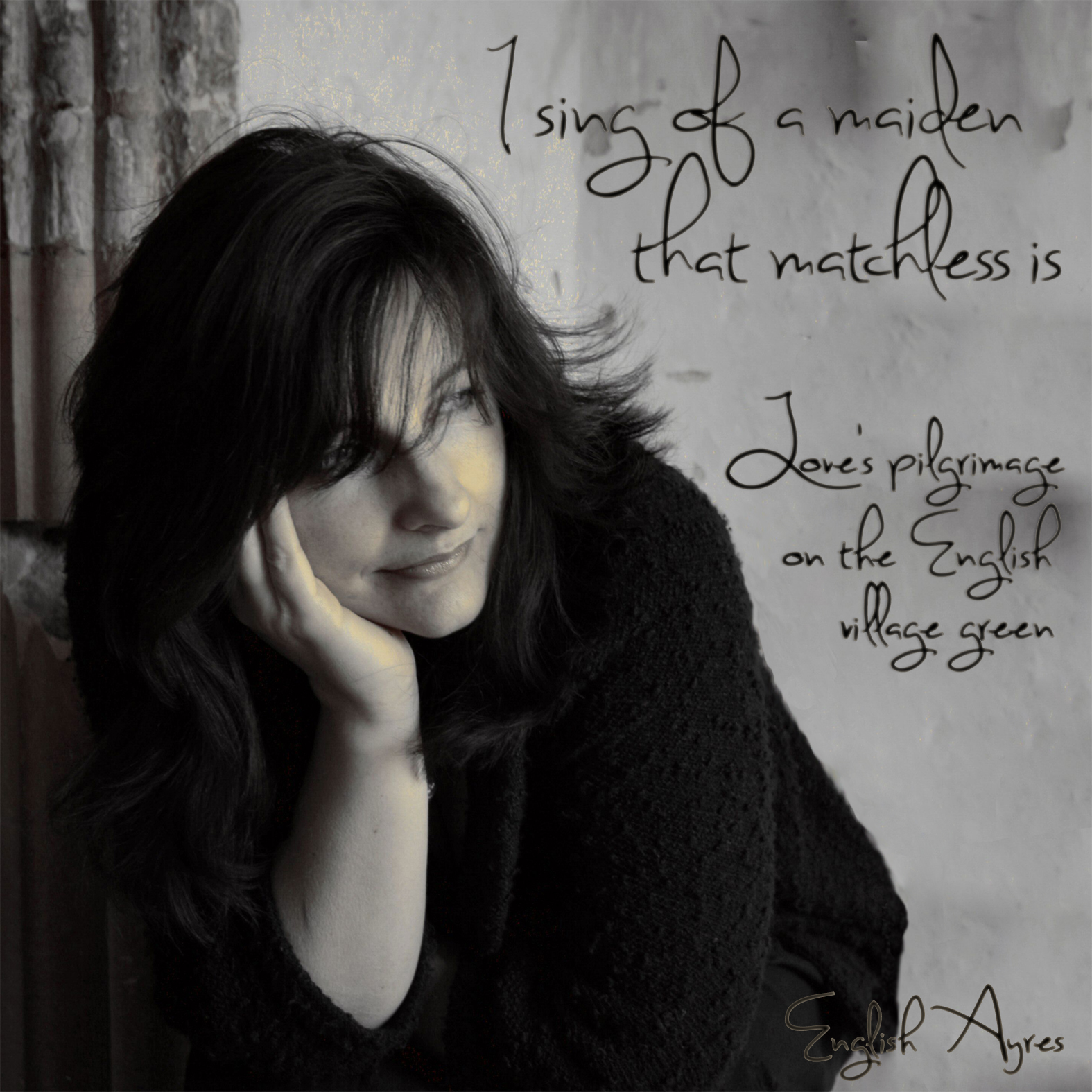
 English Ayres : I sing of a maiden that matchless is.
Traditional early english music. I sing of a maiden that matchless is, but what maiden? A rosy-cheeked milkmaid treading the dawn dew as she goes out to milk her cows? A fine lady sighing at the window of castle tower? Or Our Lady, Queen of Heaven, Mother of God and Star of the Sea? It has been said that in mediaeval poetry you often cannot tell whether the poet is talking about his mistress or the Virgin Mary, and indeed that is neatly borne out in the lyrics of tracks 3 and 4 here, which use exactly the same imagery of a knight swearing fealty to his liege-lord - ?I am thy man, hand and foot, day and night? - to express devotion to Mary, and to a lover, respectively. Erotic love and spiritual love sat easily together in the mediaeval mind in a way that they have not done since. Conventional history would explain that the language of mediaeval courtly love suited devotional poetry because courtly love was love from afar, never to be attained or consummated, having its origins in the feelings of young squires for the castle chatelaine whose lord was away fighting the crusades, perhaps. Later, a wedge was driven between romance and religion, firstly by the Protestant reformation of the 16th century, which sharply demoted the female principle in Christianity, banishing the mystical, magical, sensual, ritual, decorative and emotional aspects of faith; and secondly by scientific rationalism. Today of course, Darwinism and neurochemistry tell us, rather unsentimentally, that romantic love is associated with the hormones oxytocin and vasopressin, and is part of a strategy evolved to ensure strong pair-bonding between the parents of the vulnerable human infant, while religious experience may be related to the hormone dimethyltriptamine, and the stimulation of the right temporal lobe of the brain.Yet for all that, could it be that the mediaevals, rather than being merely foolish and unreflective, were simply rather more honest than we are, in acknowledging the overlap between different types of love and beauty, sacred and secular, which in our modern prudery we feel embarrassed about? Many a new mother must have been surprised to discover that the strongest and purest love of all, of a mother for her child, can feel like a romantic, even erotic attachment. This album then, celebrates a melting away of customary boundaries, a glorious mediaeval mixture and muddle, if muddle it be, between the sacred and the profane, the worldly and the spiritual, as expressed in 700 years of English music. Here are religious songs which were really popular ballads, probably never sung in any church [tracks 1, 3, 20] or which present spirituality in terms either of romantic love [tracks 9, 11] or of loving human relationships [tracks 3, 5, 10]. Alongside these we have put songs which, conversely, present romantic love in spiritual terms, in the language of faithful vow and pilgrimage [tracks 4, 13, 14, 16, 17] or which stand in the courtly love tradition of devotion to an unattainably high object [tracks 4, 8, 19]. As so often in English music, the imagery of nature is a thread running through all, even in religious music, where we would not particularly expect it [tracks 1, 2, 3, 6, 7, 8, 13, 15, 18, 19]. So we have included three songs which simply celebrate nature and the English village scene; a mediaeval song in praise of ivy [6], a song describing a morris dancing contest [19], and a classic English folksong of young love in a rural setting [15]. As befits our theme, we have not kept to a strict historical order, and the mediaeval lyrics are (in the case of the Holst settings) rendered into modern English or (in the case of the original mediaeval settings) tweaked here and there so that the listener should catch as much as possible without too much recourse to the lyric sheet. Songs:
1. Man may longe lives ween (anon 13th century) License Traditional early english music by English Ayres for your project. Play the music of English Ayres in your restaurant or store.
Release date: 12/21/2011 Tagged as: Classical, Medieval, Renaissance, Medieval Romance, Classical Singing, Composer: William Byrd, Composer: George Frideric Handel, Lute Recommended albums:
Downloads:
|