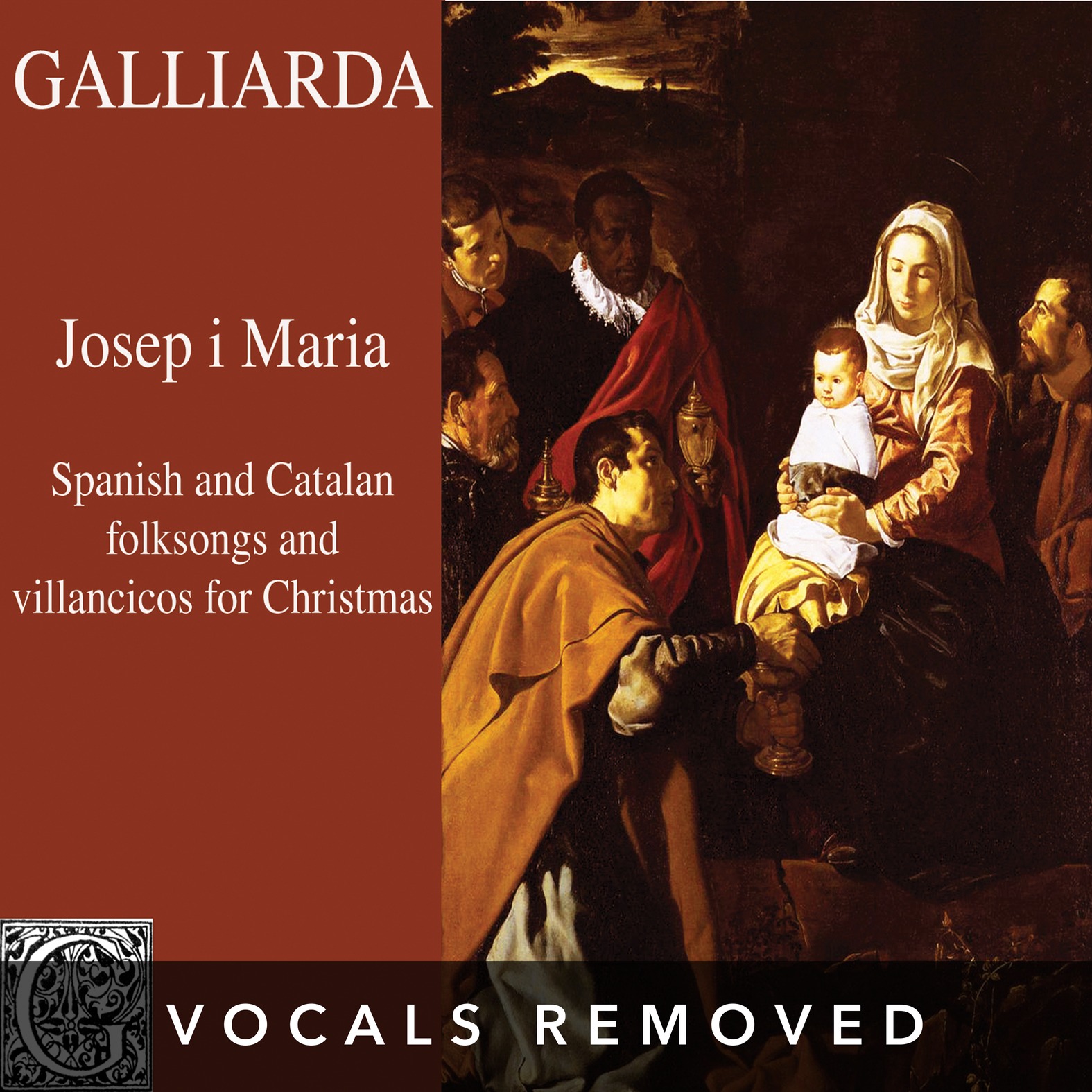
 Galliarda : Josep i Maria (Spanish and Catalan Folksongs and Villancicos for Christmas) (vocals removed). Renaissance and baroque music from byrd to handel. This is a version of Josep i Maria (Spanish and Catalan Folksongs and Villancicos for Christmas) with the vocals removed by software (Demucs). Tracks that had no singing are unchanged. The singularly rich vein of folk music in Spain and Catalonia has survived into modern times far better than its counterpart in the British Isles. Many people in Spain today still know and sing the airs which their forebears sang in centuries past. Within this tradition is a substantial corpus of music dedicated to Christmas celebrations of one sort and another; these songs also reflect the essentially bucolic nature of the communities who first developed and sang them. The lyrics enumerate offerings to the Christ child which include bread, sausage, nuts, olives, sweetmeats and all kinds of rural produce; the celebrants offer to perform their local dances, dress in colourful costumes, bring their animals to join the worship, and so forth. Naturally, the theme of the shepherds at the Nativity features prominently, and of course the biblical travails of Joseph, Mary and their infant son must have struck a familiar chord in the minds of a peasant community. The rugged geography of the Iberian peninsula has also contributed to regional traditions being maintained well into modern limes. The Spanish term villancico is most usually translated as "carol", though it does not carry the Christmas connotations of the English word. In Catalonia nadala or in Camille villancico de Navidad would be the usual definition. Many other forms of villancico can be defined, though that is more often the province of musicologists rather than the progenitors of the music. The essentially naive nature of the music and lyrics lends itself eminently well to performance on historical instruments - lutes, viols, recorders, early flutes, etc. The work of 19th century collectors such as Rodríguez Marín, Inzenga, Pedrell and their contemporaries has been hugely expanded both by Spanish and foreign authors in more recent times, giving us a rich tapestry of folk music upon which to draw. Virtually all the songs on this disc survive as single melodies with a variety of lyrics, occasionally with a second harmonising voice. The task of preparing them for Galliarda's performance has thus involved harmonisation and the creation of quasi improvised instrumental ritornelli; with folk music there is no urtext in the conventional sense. Subsequently, the recordings are intended as entertaining arrangements, not an attempt at authentic reconstruction. In addition to the folk elements, the disc contains a gallimaufry of other pieces to complement the Iberian theme, - essentially a distillation from one of Galliarda's concert programmes. Dentro en el vergel (anon) and O Reyes Magos (Juan del Encina) are found in the Cancionero de Palacio (c.1505-20), a source which includes a number of seasonal Christmas pieces in a more courtly vein of the folk tradition. Teresica hermana, set for the vihuela by Valderrabano (Book VI, 1547) is originally a villancico by the Catalan composer Mateo Flecha. Hespañoleta is from organ tablature in Flores de Musica (1706-09), while the evergreen Canarios dance by Gaspar Sanz (1674) found new life in the 20th century in a fantasia/concerto by Joaquin Rodrigo. The Gallardas by Santiago de Murcia is from his Passacalles y Obras de guitarra of 1732. From England we have plundered several sources which can supply a Spanish flavour to our proceedings: The Spanish pavan was widely popular in the 16th century and appears in a number of instrumental guises. Tobias Hume, the rumbustious advocate of the lyra viol who certainly encountered Spanish soldiers on his military adventures, gives us A Spanish Humour for ensemble and A Cavaleiro's Humour for bass viol. John and Henry Playford's "Dancing Master" (1651 et seq.) provides us with A New Spanish Entree & Saraband. The haunting atmosphere of Noel nouvelet, is sung here in the French version. The melody is just as well-known with Spanish, Catalan and Provençal lyrics. Claude Daquin's Dixieme Noel might seem an interloper on this disc, but in fact it uses the same basic tune as Claro abril resplandeció, itself an air better known in Catalonia as El desembre congelat or La Nit de Nadal (Christmas Night). Finally, the Balls de bastons is our own medley of traditional Catalan dances such as one might hear even today accompanying sardanas on a mellow evening in Barcelona. Songs:
1. El Petit Vaillet (vocals removed) Buy this album for $8: 100% goes to the musician. Download it as MP3, AAC, ALAC, FLAC, OGG or WAV. Using this music in a project? Members can use it under the Magnatune Project Licence. For programs and AI agents: this album as JSON, the Magnatune API and llms.txt.
Release date: 10/21/2026 Tagged as: Classical, Medieval, Renaissance, Baroque, Classical Singing, Cello, Folk, Lute, Recorder, Vihuela, Instrumental, Vocals Removed Recommended albums:
Downloads:
|